
TPMS - Galerie 2
In dieser Galerie finden Sie für diverse TPMS (s. rechts) Einheitszellen (engl. unit cells) der Objekte
- TPMS mit ϕ (x,y,z) = 0 als 360°-Animation
- Sheet mit | ϕ (x,y,z) | ≤ d, d ∈ |R+
- Solid A mit ϕ (x,y,z) > 0
- Solid B mit ϕ (x,y,z) < 0
- TPMS mit ϕ (x,y,z) = cpinch (360°-Animation)
und ggf. weitere Grafiken. Bezüglich Nomenklatur siehe TPMS – Einführung.
Die TPMS-Flächen wurden mit dem Graphing Calculator 3D erzeugt (Funktion und Werte für d und cpinch s. Tabelle am Seitenende), für die "physikalischen" Modelle Sheet, Solid A und
Solid B wurde die Software MSLattice verwendet.
C (D) • C (D∗), Complementary D
ϕ (x,y,z) = C3x+yCz − S3x−ySz + Cx+3yCz + Sx−3ySz + Cx−yC3z − Sx+yS3z
C (D) - TPMS
C (D) - TPMS, c = cpinch.1
C (D) - TPMS, c = - cpinch.1
C (D) - TPMS, c = cpinch.2
C (D) - TPMS, c = - cpinch.2
C (D) - TPMS ('Rainbow')


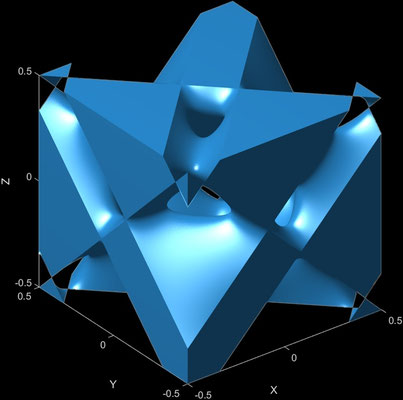
C (D) - Sheet
C( D) - Solid A
C (D) - Solid B
alternativ: ϕ (x,y,z) = C3xCyCz − S3xSySz + CxC3yCz − SxS3ySz + CxCyC3z − SxSyS3z
C (D) alternativ - TPMS
C (D) alternativ - TPMS, c = cpinch
C (D) alternativ - TPMS, c = - cpinch
C (D) alternativ - TPMS ('Rainbow')
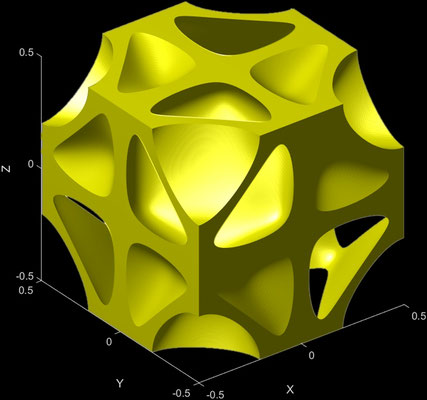


C (D) alternativ - Sheet
C (D) alternativ - Solid A
C (D) alternativ - Solid B
Gyroid • G Surface, Schoen G, Schoen Gyroid, Y*
ϕ (x,y,z) = CxSy + CySz + CzSx

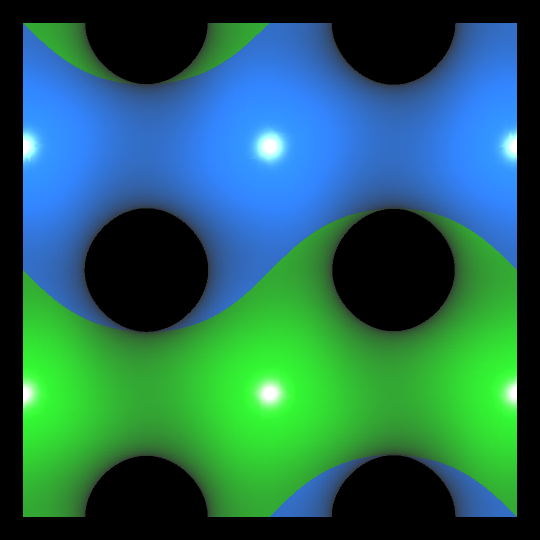


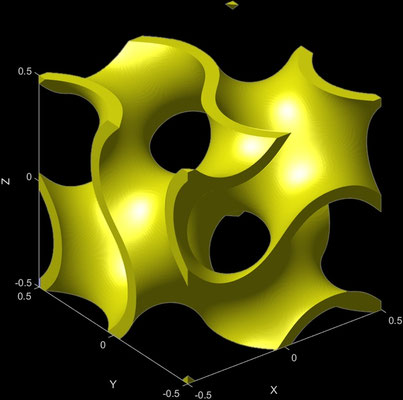


Gyroid - Sheet
Gyroid - Solid A
Gyroid - Solid B
Gyroid mit eingebetteten Zylindern
In der Grafik links wurden in die Gyroid-Einheitszelle 18 Halb-/Zylinder mit gleichem Radius eingebettet. Die Koordinatenwerte der Zylindermittelachsen sind Vielfache von 1/4, die Öffnungen im Gyroid sind jedoch nicht kreisrund (s.o. bei Ansichten der Unit Cell), so dass für den Radius r nicht der Wert 1/8 = 0.125 sondern 0.122 verwendet wurde und so die Gyroid-fläche nicht die Zylinder-wände durchdringt.
Schnittmenge aus Kugel mit r=1
und Gyroid mit p=4
C (G) • Complementary G, C(Y**), Complementary Y**
ϕ (x,y,z) = 3
(SxCy + SyCz + CxSz) + 2 (S3xCy + S3yCz + CxS3z) –
2 (SxC3y + SyC3z + C3xSz)
C (G) - TPMS
C (G) - TPMS, c = cpinch.1
C (G) - TPMS, c = - cpinch.1
C (G) - TPMS, c = cpinch.2
C (G) - TPMS, c = - cpinch.2
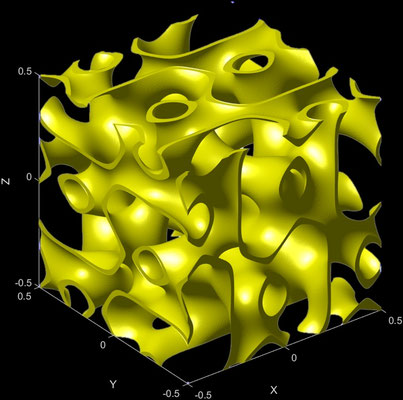
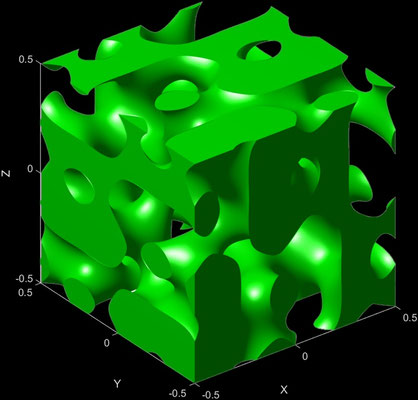
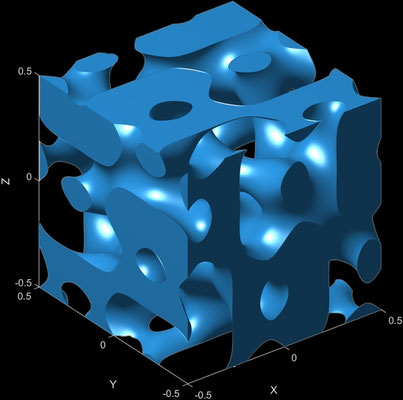
C (G) - Sheet
C (G) - Solid A
C (G) - Solid B
S • Fisher–Koch S, S*
ϕ (x,y,z) = C2xSyCz + CxC2ySz + SxCyC2z
S - TPMS
S - TPMS, c = cpinch
S - TPMS, c = - cpinch
S - TPMS ('bunt')
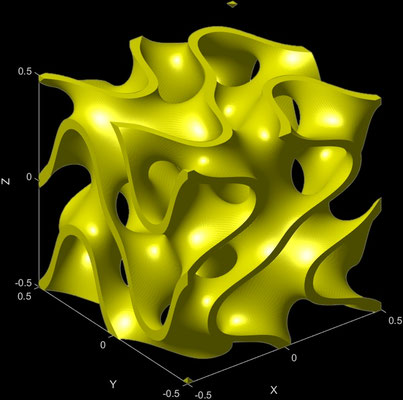

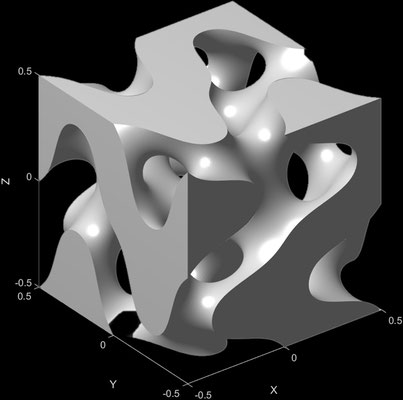
S - Sheet
S - Solid A
S - Solid B
C (S) • Complementary S, Fisher–Koch C(S)
ϕ (x,y,z) = (C2x + C2y + C2z) + 2 (S3xS2yCz + CxS3yS2z + S2xCyS3z)
+
2 (S2xC3ySz + SxS2yC3z +
C3xSyS2z)
C (S) - TPMS, p=π
C (S) - TPMS
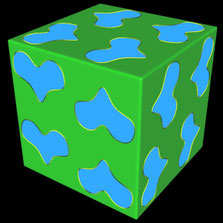
C (S) - eine ♥-liche Fläche ;-)
C(S) - TPMS, c = cpinch
C(S) - TPMS, c = - cpinch
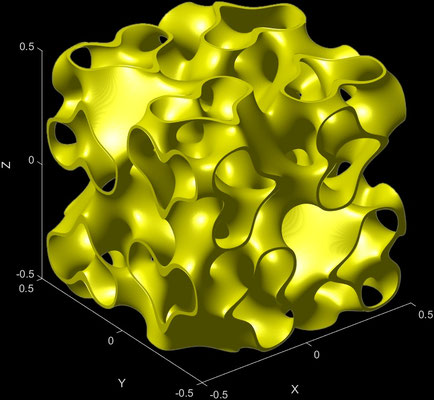


C (S) - Sheet
C (S) - Solid A
C (S) - Solid B
Die folgende Tabelle enthält die Funktionen und Parameter mit denen die Flächen und Festkörper auf dieser Seite erstellt wurden. Die für eine Fläche jeweils angegebene zweite Funktion enthält die Zeichenfolge ".*" für die multiplikative Verknüpfung und kann so direkt in MSLattice eingefügt werden. Falls nicht anders angegeben, ist jeweils p = 2π.
| TPMS | ϕTPMS | F(x,y,z) für MSLattice | d |
| C (D) |
cos(p(3x+y))cos(pz)−sin(p(3x−y))sin(pz)+cos(p(x+3y))cos(pz)+sin(p(x−3y))sin(pz)+ cos(p(x−y))cos(p*3z)−sin(p(x+y))sin(p*3z)
cpinch.1 = ± 0.158 cpinch.2 = ± 0.272
cos(pi.*(3.*x+y)).*cos(pi.*z)-sin(pi.*(3.*x-y)).*sin(pi.*z)+ p = π cos(pi.*(x+3.*y)).*cos(pi.*z)+sin(pi.*(x-3.*y)).*sin(pi.*z)+ cos(pi.*(x-y)).*cos(pi.*3.*z)-sin(pi.*(x+y)).*sin(pi.*3.*z)
alternativ:
cos(3p*x)cos(p*y)cos(p*z)-sin(3p*x)sin(p*y)sin(p*z)+cos(p*x)cos(3p*y)*cos(p*z)-sin(p*x)sin(3p*y)sin(p*z)+cos(p*x)cos(p*y)cos(3p*z)-sin(p*x)sin(p*y)sin(3p*z)
cpinch = ± 0.111
cos(3.*pi.*x).*cos(pi.*y).*cos(pi.*z)-sin(3.*pi.*x).*sin(pi.*y).*sin(pi.*z)+ cos(pi.*x).*cos(3.*pi.*y).*cos(pi.*z)-sin(pi.*x).*sin(3.*pi.*y).*sin(pi.*z)+ cos(pi.*x).*cos(pi.*y).*cos(3.*pi.*z)-sin(pi.*x).*sin(pi.*y).*sin(3.*pi.*z) |
0.25 |
| Gyroid |
cos(px)sin(py)+cos(py)sin(pz)+cos(pz)sin(px)
cpinch = ± 1.414
cos(2.*pi.*x).*sin(2.*pi.*y)+cos(2.*pi.*y).*sin(2.*pi.*z)+cos(2.*pi.*z).*sin(2.*pi.*x) |
0.25 |
| C (G) |
3(sin(px)cos(py)+sin(py)cos(pz)+cos(px)sin(pz))+2(sin(3px)cos(py)+sin(3py)cos(pz)+ cos(px)sin(3pz))−2(sin(px)cos(3py)+sin(py)cos(3pz)+cos(3px)sin(pz))
cpinch.1 = ± 3.419 cpinch.2 = ± 4.242
3.*(sin(2.*pi.*x).*cos(2.*pi.*y)+sin(2.*pi.*y).*cos(2.*pi.*z)+cos(2.*pi.*x).*sin(2.*pi.*z))+ 2.*(sin(3.*2.*pi.*x).*cos(2.*pi.*y)+sin(3.*2.*pi.*y).*cos(2.*pi.*z)+ cos(2.*pi.*x).*sin(3.*2.*pi.*z))-2.*(sin(2.*pi.*x).*cos(3.*2.*pi.*y)+ sin(2.*pi.*y).*cos(3.*2.*pi.*z)+cos(3.*2.*pi.*x).*sin(2.*pi.*z)) |
0.25 |
| S |
cos(2px)sin(py)cos(pz)+cos(px)cos(2py)sin(pz)+sin(px)cos(py)cos(2pz) cpinch = ± 0.749
cos(2.*2.*pi.*x).*sin(2.*pi.*y).*cos(2.*pi.*z)+cos(2.*pi.*x).*cos(2.*2.*pi.*y).*sin(2.*pi.*z)+ sin(2.*pi.*x).*cos(2.*pi.*y).*cos(2.*2.*pi.*z) |
0.5 |
| C (S) |
(cos(2px)+cos(2py)+cos(2pz))+2(sin(3px)sin(2py)cos(pz)+cos(px)sin(3py)sin(2pz)+ sin(2px)cos(py)sin(3pz))+2(sin(2px)cos(3py)sin(pz)+sin(px)sin(2py)cos(3pz)+ cos(3px)sin(py)sin(2pz))
cpinch = ± 1.407
(cos(2.*pi.*2.*x)+cos(2.*pi.*2.*y)+cos(2.*2.*pi.*z))+ 2.*(sin(2.*pi.*3.*x).*sin(2.*pi.*2.*y).*cos(2.*pi.*z)+ cos(2.*pi.*x).*sin(2.*pi.*3.*y).*sin(2.*pi.*2.*z)+ sin(2.*pi.*2.*x).*cos(2.*pi.*y).*sin(2.*pi.*3.*z))+ 2.*(sin(2.*pi.*2.*x).*cos(2.*pi.*3.*y).*sin(2.*pi.*z)+ sin(2.*pi.*x).*sin(2.*pi.*2.*y).*cos(2.*pi.*3.*z)+ cos(2.*pi.*3.*x).*sin(2.*pi.*y).*sin(2.*pi.*2.*z)) |
0.25 |